St Pauli tickets & safe packages · Millerntor-Stadion, Hamburg.
Hamburg, Germany
Millerntor-Stadion
Bundesliga
Planning a trip to see St Pauli this season is straightforward when you can compare what's available in one place. On this site, you'll find options from around 15 different companies — from those selling individual match tickets to those offering full travel packages with flights and hotel included. The range means there's usually something that fits most budgets and travel styles. Some companies focus purely on the match experience, while others bundle accommodation in central Hamburg with the ticket. It's worth looking at what's actually included in each offer rather than just the headline price — transport to the stadium, hotel location and check-in flexibility can all vary. The comparison here covers both options for a quick weekend trip and longer stays if you want more time in Hamburg. Once you've found what suits you, the purchase is completed directly on the seller's website, where payment methods and booking conditions may differ between providers.
When you compare football trips to St Pauli, the differences between companies become clear quite quickly. One might offer a hotel closer to the stadium while another includes a guided city tour alongside the match. A football tour to Hamburg can be as simple as a single match ticket or as comprehensive as a multi-night stay with pre-arranged transport. The companies listed here vary in what they include, so the comparison isn't just about price — it's about finding the right combination of services. Some packages are designed for solo travellers, others clearly cater to groups or families. Check whether airport transfers are included and what happens if the match is rescheduled, since each company has its own terms. The details are available on each seller's page, and that's where the actual booking takes place. What's on this site is the overview — enough to get a clear picture before you commit to anything.
Getting St Pauli tickets through the club directly is possible in theory, but it typically requires membership and even then availability isn't guaranteed — especially for home matches with strong demand. Buying tickets for St Pauli through one of the partners listed here is a more reliable route, as you get confirmation without having to navigate the club's membership system. Match tickets are listed by several sellers on this site, with varying price points depending on the stand and the fixture. Some companies sell tickets only, which is useful if you've already sorted your travel and accommodation separately. The ticket category matters — standing areas in the south stand tend to sell faster than seated sections, and the atmosphere differs noticeably between parts of the ground. Check what section is included in any offer before booking. More details about seating and inclusions are available on the individual seller's pages.
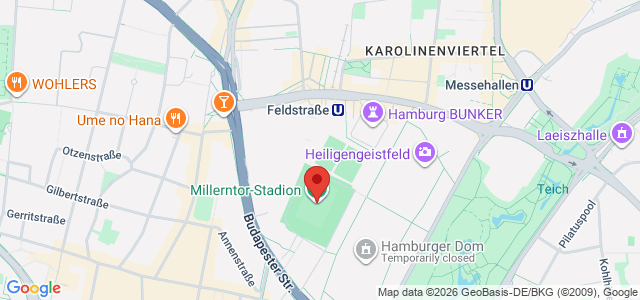
The area around Millerntor-Stadion is the Reeperbahn district — Hamburg's St Pauli neighbourhood, which is lively well before kick-off. Pubs and bars along Reeperbahn and the surrounding streets fill up with supporters a couple of hours before the match. Heiligengeistfeld, just next to the stadium, is a natural gathering point. The Jolly Roger bar on Reeperbahn is a well-known pre-match spot, and there are plenty of other options within a short walk. As a visiting fan, arrive at least an hour before kick-off — the area gets busy and queues at turnstiles can take time. Visiting supporters are typically allocated a specific section, so check your ticket for the correct entrance. The stadium is compact and the crowd is close to the pitch, which means noise carries well. Bring cash — some food and drink stalls inside don't accept cards. The atmosphere inside is notably loud even for lower-profile fixtures.
Millerntor-Stadion sits right in the heart of the St Pauli district, making it one of the more accessible grounds in German football. The nearest S-Bahn station is Reeperbahn, served by lines S1, S2 and S3 — it's roughly a five-minute walk from there to the stadium. From Hamburg Central Station (Hamburg Hauptbahnhof), the S-Bahn journey takes around five minutes, and the station is well connected to both the airport and the wider city. Bus lines also serve the area, with stops on Budapester Strasse close to the ground. Walking from the city centre is entirely manageable — it takes around 20 to 25 minutes on foot from the Hauptbahnhof through the Neustadt district. Driving is not recommended on match days; parking near the stadium is limited and the surrounding streets get congested. The U-Bahn line U3 stops at St Pauli station, which is also within comfortable walking distance of the ground.
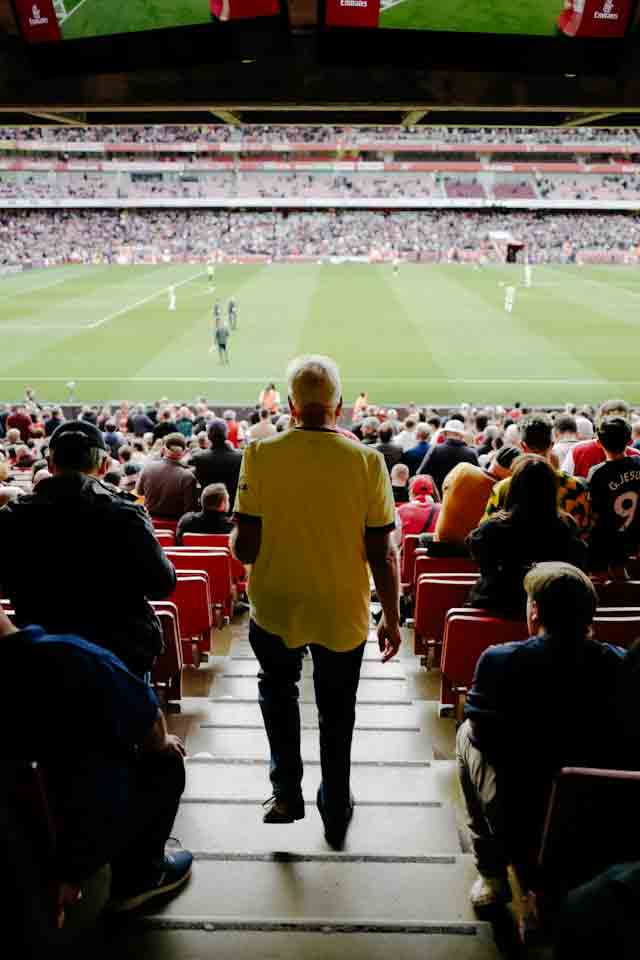
Millerntor-Stadion has a capacity of approximately 29,000, split between standing and seated areas. The south stand — the Gegengerade — is the traditional home end and the loudest section of the ground, with a large standing terrace that generates most of the noise during matches. The stadium has been redeveloped in stages over the years, with the current version largely taking shape from the mid-2000s onwards. It's a compact, four-sided ground with good sightlines from most positions. One distinctive feature is the skull-and-crossbones flag — the club's unofficial symbol — which appears throughout the stadium on banners and scarves. The main stand runs along the north side and contains most of the seated capacity. Visiting fans are usually placed in a section of the east or west stand. The stadium is entirely within the urban fabric of the neighbourhood, with buildings and streets right up against the exterior — there's no large forecourt or car park surrounding it.
A package trip to St Pauli makes sense if you're travelling from further away and want everything sorted in one booking. Travel packages typically combine a match ticket with hotel accommodation, and sometimes flights depending on the company. That can simplify planning considerably compared to arranging each element separately. On the other hand, if you're already in Hamburg or have accommodation sorted, a ticket-only option is more practical and usually cheaper. The sellers on this site offer both, so it's worth checking what's available for the specific fixture you're interested in. Package terms vary — some include breakfast, some don't; some have flexible check-out, others are fixed. The full details are on each company's own page. For a first-time visitor to Hamburg, a travel package often works well because it removes some of the uncertainty around accommodation location and match-day logistics. For repeat visitors who know the city, a standalone ticket is often the simpler choice.
St Pauli's most significant rivalry is with Hamburger SV, the city's other major club. The Hamburg derby carries considerable weight locally, though the two clubs have spent stretches of recent years in different divisions, which has limited the frequency of meetings. When they do meet, it's the standout fixture of the season for supporters of both clubs. Beyond Hamburg, St Pauli have a notable rivalry with Hansa Rostock, rooted in political and cultural differences between the two sets of supporters — St Pauli's left-leaning fanbase contrasts sharply with sections of the Rostock support. There is also a recognised rivalry with Dynamo Dresden, again partly ideological in character. St Pauli's identity as a club is closely tied to its supporter culture, which means these rivalries often carry more than just sporting significance. The Hamburg derby remains the one that most visiting fans are keen to see.
St Pauli was founded in 1910 and spent much of its history moving between the top two divisions of German football. The club gained wider recognition from the late 1980s onwards, when its counter-cultural image attracted a new type of supporter and began drawing attention beyond Hamburg. That reputation has grown steadily since, making St Pauli one of the more recognisable mid-tier clubs in Europe despite never winning a major national title. The club has produced and attracted a number of notable players over the years. Gerald Asamoah, the German-Ghanaian forward, had a stint at the club. Deniz Naki, the German-Kurdish midfielder, came through the academy and made a strong impression before moving on. More recently, the club has developed young talent through its academy system and brought in experienced players from across Europe and beyond. St Pauli's promotion back to the Bundesliga for the 2024/25 season marked a significant moment after years in the second division.
A football trip to Hamburg gives you plenty to work with beyond the match. The Speicherstadt — Hamburg's historic warehouse district — is worth an afternoon, and the nearby HafenCity is one of Europe's larger urban development projects, with waterfront architecture and good restaurants. The Elbphilharmonie concert hall is a striking building on the harbour and offers guided tours if you're interested in architecture. The Reeperbahn area around the stadium is worth exploring during the day when it has a different character to the evening — there are independent shops, cafés and the Beatles-Platz, which marks the area where the band played early in their career. The Schanzenviertel neighbourhood, just north of the stadium, has a dense collection of independent bars, restaurants and street food spots. Hamburg's fish market on the Elbe runs on Sunday mornings and is a Hamburg institution. The city has a good public transport network, so getting between neighbourhoods is straightforward.