Napoli tickets & safe packages · Stadio San Paolo, Naples.
Naples, Italy
Stadio San Paolo
Serie A
Planning a trip to see Napoli play at home is straightforward when you know where to look. On this site, you can compare options from around 15 different companies — ranging from sellers offering individual match tickets to operators putting together full packages with flights and hotel included. The range means you can tailor the trip to what suits you, whether that's a quick weekend away or something more extended. Prices, inclusions and conditions vary between providers, so it's worth taking a moment to look at what each company actually offers rather than just the headline figure. Some companies include transport to the stadium or pre-match hospitality; others keep it simple. Payment methods and cancellation terms also differ, so check those details on the individual seller's page before committing. Buying through one of the listed partners is a reliable way to secure your place, since getting tickets directly through Napoli requires club membership and still doesn't guarantee availability.
When you compare football trips to Napoli on this site, the point isn't just to find the cheapest option — it's to understand what you're actually getting. A lower-priced listing might cover the ticket only, while another includes a centrally located hotel and airport transfers. A football tour that bundles everything together can end up being better value and far less hassle to organise independently. The companies listed here cover a range of match categories, from Serie A home games to European fixtures, and the selection shifts depending on the fixture calendar. Some providers focus purely on tickets, while others build full travel packages around the match. Comparing them side by side gives you a clearer picture of the differences in content, not just cost. Once you've found something that works, the actual booking takes place directly on the seller's website, where you'll also find full terms and conditions.
Napoli tickets can be bought through several of the companies listed on this site, covering everything from standard league matches to cup and European fixtures. Match tickets are listed by different sellers, so the category, stand location and price will vary depending on who you buy from. Tickets for Napoli matches in Serie A are generally more available for mid-table opponents, while fixtures against Roma, Juventus or in European competition tend to go faster. Buying through one of the partners here means you'll have a confirmed seat without needing to navigate the club's own membership system — Napoli requires a fan card (Fidelity Card) for direct purchases, which adds an extra step for visiting fans. The sellers on this site handle that process on your behalf. Check what section of the stadium the ticket covers, since the atmosphere and sightlines differ noticeably between the curvas and the main stands.
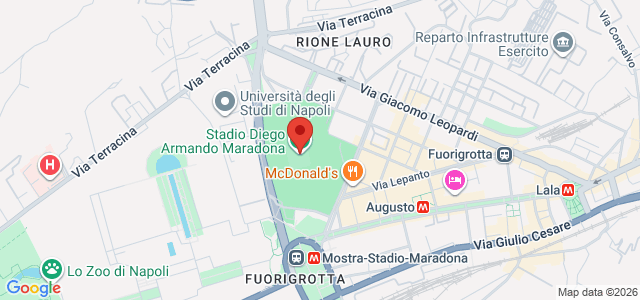
Arriving at Stadio San Paolo as a visiting fan, you'll want to get there well before kick-off — at least 90 minutes early is sensible, as queues at the turnstiles can be slow and security checks are thorough. Visiting supporters are typically placed in a designated away section, so check your ticket carefully for the correct entrance. The area around the stadium in Fuorigrotta isn't particularly geared towards pre-match tourism, but there are bars along Viale Augusto and near the Mostra d'Oltremare complex where locals gather before games. Avoid wearing away colours too visibly in the streets around the stadium — Napoli fans are passionate and the atmosphere outside can be intense, particularly for big matches. Smoking is not permitted inside the stadium. Cash is useful for street food and smaller bars near the ground. The local street food scene is genuinely good — grab a pizza fritta or a cuoppo from one of the vendors near the metro.
The stadium sits in the Fuorigrotta district, west of the city centre, and is well connected by public transport. The most direct option is Line 2 of the Naples Metro — get off at Campi Flegrei station, from where it's around a 10-minute walk to the ground. Alternatively, Line 6 stops at Mostra, which is even closer to the stadium entrance. Bus routes also serve the area, including lines that run from Piazza Garibaldi and the city centre, though these can get congested on match days. The Circumflegrea suburban rail line stops at Fuorigrotta, which is another option if you're coming from further west. Driving is possible but not recommended on match days — parking around the stadium is limited and traffic backs up significantly after the final whistle. A taxi or ride-share from the centre takes roughly 20–25 minutes outside peak hours, longer on match days.
The stadium was built in the 1950s and has a capacity of approximately 54,000, making it one of the larger grounds in Italian football. It was renamed Stadio Diego Armando Maradona in 2020, in honour of the club's most iconic player, though many locals and older fans still refer to it by its original name. The ground has a distinctive oval shape with a running track around the pitch, which means some seats — particularly in the lower tiers — are further from the action than you might expect at a more modern stadium. The two curvas, Curva A and Curva B, are where the ultras and most vocal supporters gather, and the noise level there during big matches is something else entirely. The upper tiers offer better sightlines. The stadium has hosted major international matches and was a venue during the 1990 FIFA World Cup. Renovation work has been carried out in recent years to improve facilities.
A package trip to Napoli typically includes the match ticket, hotel accommodation and sometimes flights — all arranged through one provider. This can simplify planning considerably, particularly if you're travelling from far away or want to combine the match with a few days in Naples. A travel package tends to work out well for those who don't want to piece everything together separately, and it also means one point of contact if something needs to change. On the other hand, if you already have accommodation sorted or prefer flexibility in how you travel, buying a standalone ticket through one of the listed sellers makes more sense. Both options are available on this site. The main thing to compare in a package isn't just the total price — it's which hotel, how close to the match date the booking is, and what happens if the fixture is rescheduled. Those details are on each seller's own page.
Napoli's most significant rivalry is with Juventus, a fixture that carries a strong north-south dimension in Italian football. The match between the two clubs, sometimes called the Derby d'Italia in a broader sense, reflects a cultural and economic divide that goes well beyond football. Relations between the fan bases have historically been hostile, and matches between the sides are always high-stakes. The rivalry with Roma is also significant, particularly as both clubs compete regularly for the top positions in Serie A. Locally, Napoli don't have a direct city rival in the top flight, but matches against Inter and Milan draw strong interest given the historical competition for the Scudetto. The fixture against Juventus in particular tends to sell out quickly and generates a charged atmosphere inside the stadium, so if that's the match you're targeting, planning well in advance is advisable.
Napoli was founded in 1926 and spent much of its early history moving between the top two divisions of Italian football before establishing itself as a genuine force in Serie A during the 1980s. The arrival of Diego Maradona in 1984 transformed the club — he led Napoli to two Serie A titles, in 1987 and 1990, as well as a UEFA Cup victory in 1989. Those years remain the defining era in the club's history. After a long period without major silverware, Napoli won a third Scudetto in the 2022/23 season under Luciano Spalletti, with Victor Osimhen and Khvicha Kvaratskhelia among the key figures. The Georgian winger Kvaratskhelia in particular became one of the most talked-about players in European football that season. The club has also produced and developed a number of Italian internationals over the years, and has consistently attracted high-profile signings from across Europe and South America.
A football trip to Naples gives you a good reason to spend time in one of Italy's most layered and underrated cities. The historic centre — a UNESCO World Heritage Site — is worth exploring on foot: Via Spaccanapoli cuts straight through it and gives you a sense of the city's density and energy. The National Archaeological Museum holds one of the best collections of Roman artefacts in the world, much of it recovered from Pompeii and Herculaneum, both of which are reachable by the Circumvesuviana train in under an hour. For food, the Quartieri Spagnoli neighbourhood has plenty of no-frills trattorias and pizzerias — Naples is the home of pizza, and places like Di Matteo or Sorbillo on Via dei Tribunali are well-established and popular with locals. The waterfront area around Lungomare Caracciolo is good for an evening walk. The city is compact enough that most central sights are walkable from a centrally located hotel.